
Drawer test
- During the drawer test (anterior drawer test), the hip is held in 45° flexion and the knee joint in 90° flexion, and the tibia is pulled forward with both hands.
- The foot is kept in a neutral position (the most common test position that gives the greatest degree of anterior instability), 15° external rotation (anterior + medial instability) and 30° internal rotation (anterior + lateral instability).
- Posterior cruciate ligament test (posterior drawer test) is performed in the same position but by pressing the tibia backward.
Cruciate ligament
Anterior drawer test, in neutral position

Anterior drawer test, in internal and external rotated position


Lachmann test
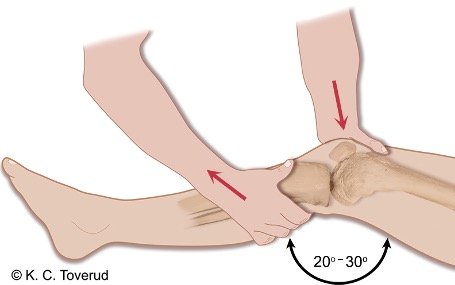
- In the Lachmann test, the patient lies down and the knee is held in 15-30° flexion while the thigh is stabilized with one hand and the other pulls the tibia forward
- Note if there is a lateral subluxation of the tibia (pivoting) > 5mm and if the end-feel is soft instead of hard
Cruciate ligaments, Lachmann's test
Lachmann's test
