
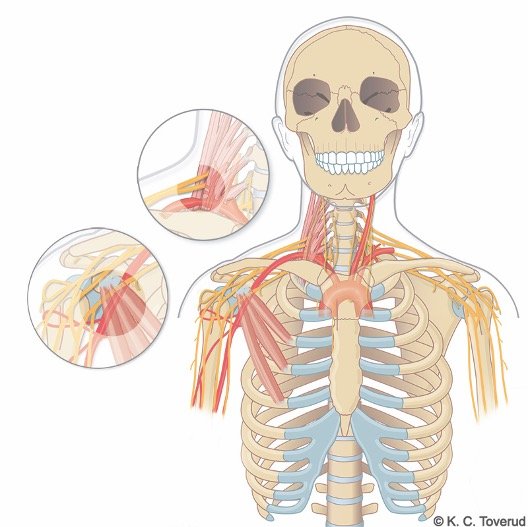
- Characteristics are pain, weakness, numbness, or paresthesias in the arm
- Caused by compression of the subclavian a./v., axillary a./v., or brachial plexus due to
- Narrowing under a cervical rib
- Narrowing in the scalene passage (anterior scalene syndrome)
- Narrowing between the clavicle and first rib (costoclavicular syndrome)
- Narrowing under the pectoralis minor muscle
Adson’s test
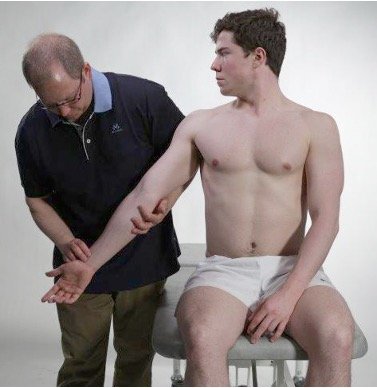
- Tests for signs of compression of the subclavian artery between a cervical rib and the anterior scalene muscle
- Tested with the patient in a sitting position, the arms resting on the knees, the patient takes a deep breath in, rotates the head towards the painful side
- The position is held for at least ½ minute and it is recorded whether the pulse in the radial artery weakens
Test characteristics: Sens 79, Spec 76, LR+3.3, LR-0.27
Wright's hyperabduction test
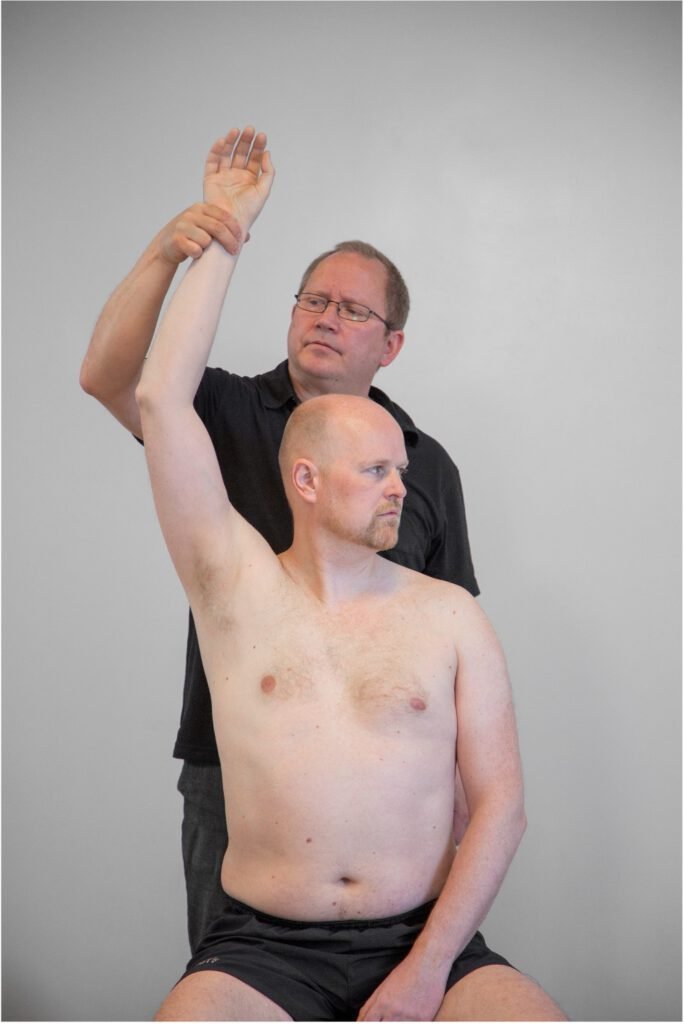
- Tests if there are signs of compression of neurovascular structures under the pectoralis minor muscle
- Full abduction of the arm, head rotated towards the asymptomatic side
- Registers whether there is reduced pulse in the radial artery
Test characteristics: Sens 70, Spec 53, LR+1.5, LR-0.56
Roos test


- Tests for fatigue, heaviness, numbness, and tingling in the arms
- Not a very specific test
- Provoked by 3 minutes of opening and closing the hands with the arms at 90° abduction and 90° flexion at the elbows
Test characteristics: Sens 84, Spec 30, LR+1.2, LR-0.53
Symptoms of Thoracic Outlet Syndrome (TOS)
- Neck, shoulder, arm pain
- Numbness in arm, hand, fingers
- Reduced blood circulation, can cause changes in skin color
- Muscle weakness in shoulder, arm, hand