N. radialis, anatomy
- Runs along the posterior part of the humerus and then curves around to the front of the humerus in the radial nerve groove and continues down to the front of the lateral humeral epicondyle
- The radial nerve divides into four sensory branches and one deep motor branch
- The deep motor branch passes through the supinator muscle and continues down the forearm along the posterior interosseous membrane
Radial nerve, motor function
- Elbow extension (triceps brachii muscle)
- Elbow flexion (brachioradialis muscle)
- Forearm supination (supinator muscle)
- Wrist extension (M. extensor carpi radialis longus, M. extensor carpi radialis brevis, M. extensor carpi ulnaris)
- Finger extension (M. extensor digitorum, M. extensor digiti minimi, M. extensor indicis)
- Thumb abduction (M. abductor pollicis longus) and extension (M. extensor pollicis longus, M. extensor pollicis brevis)
N. radialis, sensory function
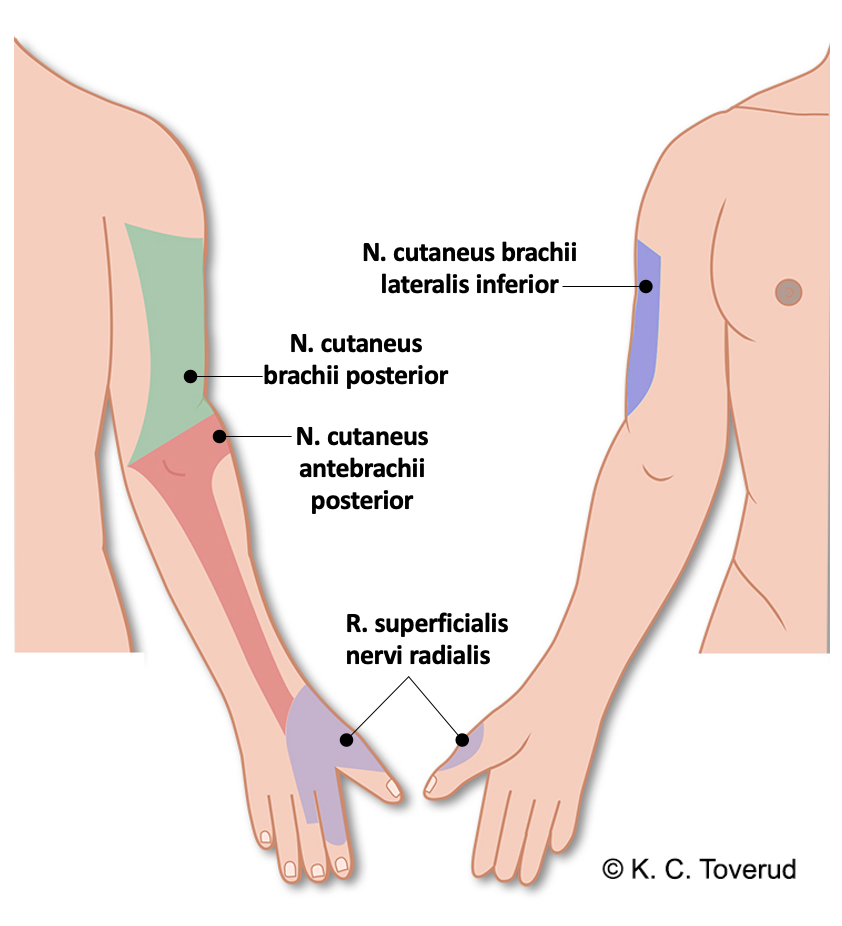
Sensory branches
- Upper arm/forearm
- N. cutaneus brachii lateralis inferior
- N. cutaneus brachii posterior
- N. cutaneus antebrachii posterior
- Hand
- R. superficialis nervi radialis
- Medial branch: Ulnar half dorsally of the thumb, dorsal side of the index finger, middle finger, and radial half of the ring finger
- Lateral branch: Radial dorsal part of the thumb
- R. superficialis nervi radialis
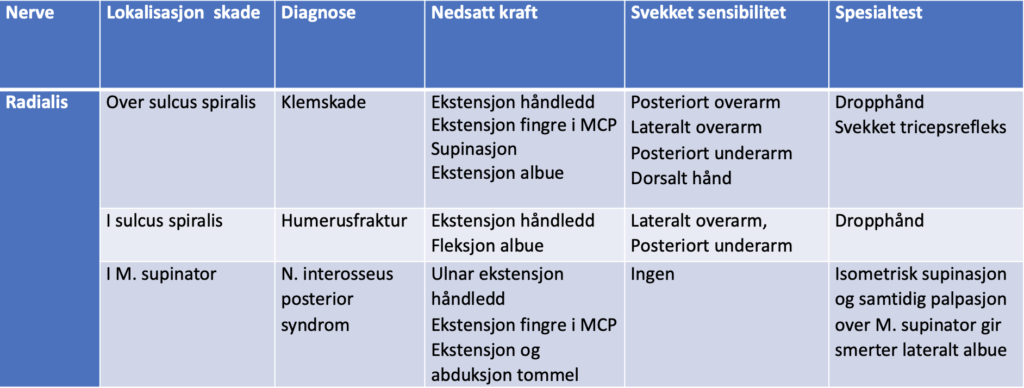
Injury above the spiral groove, anatomy
- Caused by a compression of the N. radialis near the axilla or in the upper arm above the radial groove
Injury above the spiral groove, clinical
- Often called 'Radial nerve palsy'
- Honeymoon palsy, Saturday night palsy
- Can cause wrist drop, weakened strength in forearm supination, and weakened elbow extension strength
- Sensory loss in all four sensory branches of the radial nerve (posterior brachial cutaneous nerve, inferior lateral brachial cutaneous nerve, posterior antebrachial cutaneous nerve, and superficial branch of the radial nerve)
Injury in the spiral groove, anatomy
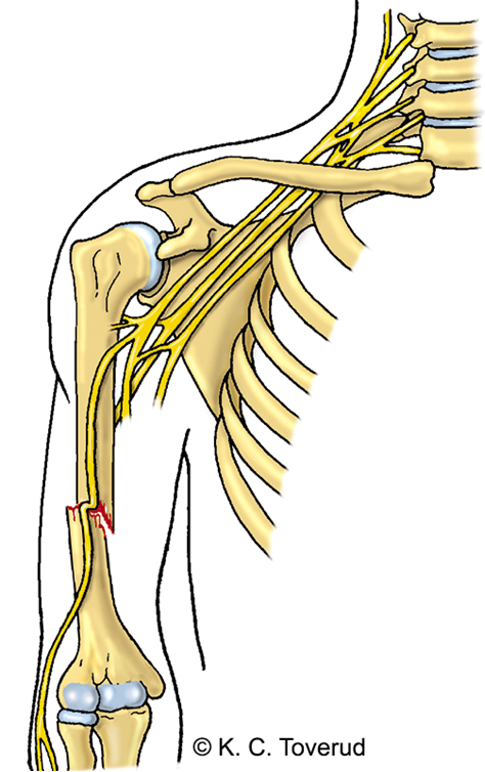
- Nerve injury at the level of the spiral groove causes weakness in all muscles distal to the elbow
- Causes wrist drop, weakened supination strength, and weakened elbow flexion strength
- Sensory loss in two of the four sensory branches of the radial nerve (N. cutaneus brachii lateralis inferior, N. cutaneus antebrachii posterior), R. superficialis nervi radii, and N. cutaneus brachii posterior bypasses the radial groove and is not injured.
Injury in the radial groove, clinical signs
- Nerve injury occurs in 15% of cases with midshaft humerus fracture.
- If the nerve injury occurs acutely with the fracture, the prognosis is good; 90% recover within a few months.
- The nerve is usually not cut, but being pulled at the moment of injury causes a temporary loss of function.
Injury above and in the spiral groove, wrist drop test

- Wrist drop at rest and during attempts at extension
- Caused by weakness in wrist extension, thumb extension, and MCP extension
- IPL extension normal due to intact nerve supply to the lumbricals from the ulnar nerve
Key diagnostics, N. radialis