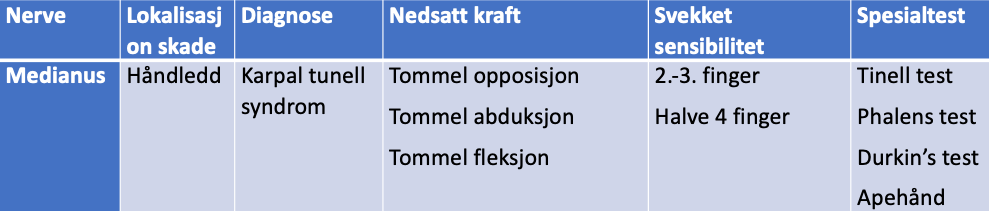
Carpal tunnel syndrome, anatomy
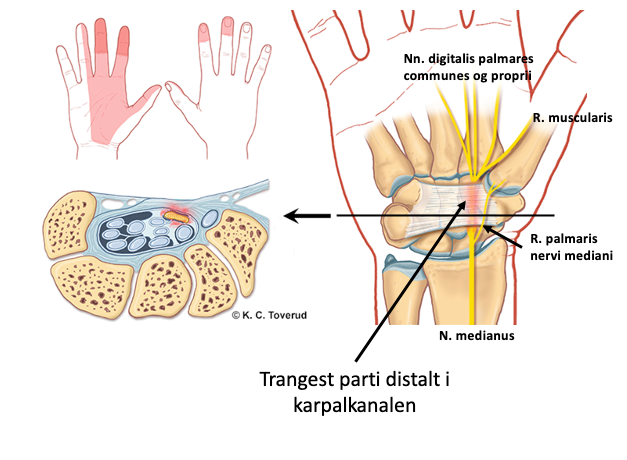
- The median nerve passes through the carpal tunnel along with the flexor digitorum superficialis, flexor digitorum profundus, and flexor pollicis longus
- After the carpal ligament, the nerve divides into a motor branch and a digital cutaneous branch
- The motor branch innervates the thenar muscles (opponens pollicis, abductor pollicis brevis, and superficial head of flexor pollicis brevis)
- The digital branch to the index finger also contains motor innervation to the first lumbrical
- Large parts of the palm are innervated by R. palmaris of the median nerve, which branches off before the carpal tunnel. Therefore, there is no reduced sensation in the thenar area, but still pain and abnormal sensation in the thenar area
Carpal tunnel syndrome, causes
Injuries that can cause pressure on the median nerve in the carpal tunnel
- Wrist fracture
- Rheumatoid arthritis in the wrist or carpal bones

Risk factors for the development of carpal tunnel syndrome
- Female, narrower carpal canal
- Pregnancy, fluid retention
- Diabetes
- Low metabolism
- Kidney failure
- Obesity
- Work-related, vibration tool, and repetitive wrist flexion
Carpal tunnel syndrome, motor deficit
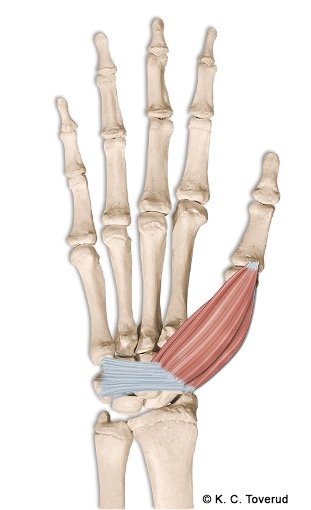
Tenara atrophy and power failure affect
- Thumb flexion
- M. flexor pollisis brevis
- Thumb abduction
- M. abductor pollicis brevis
- Thumb opposition
- M. opponens pollicis
Carpal tunnel syndrome, sensory deficits
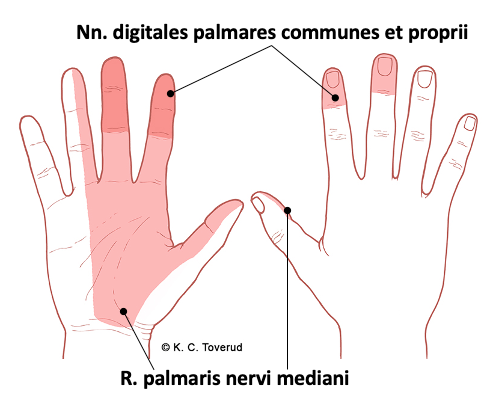
- Wakes up at night with pain and numbness, helps to shake the hand
- On clinical examination
- Hypersensitivity of the skin
- Numbness, reduced sensitivity to pinprick and touch, and reduced vibration sense
- Two-point discrimination on fingertip, normally 3-5 mm, reduced at 6-10 mm and absent when > 10 mm distance between test points
Carpal tunnel syndrome, clinical presentation
Mild
- Numbness and tingling at night
- Rare pain
- Increased vibration sense and sensitivity
- No muscle weakness or atrophy
Moderate
- Numbness and tingling also during the day
- Pain
- Reduced vibration sense and sensitivity
- Abnormal 2-point discrimination
- Positive Tinel’s and Phalen’s signs
- No muscle weakness or atrophy
Severe
- Numbness and tingling day and night
- Pain
- Weakness in muscles and atrophy
- Negative Tinel’s sign due to severe nerve damage
Carpal tunnel syndrome, Tinel test
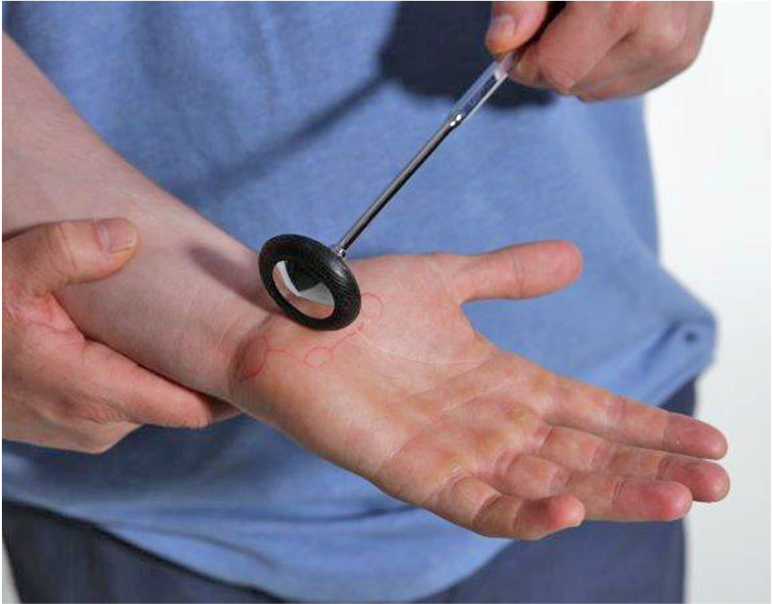
Percussion of the median nerve over the carpal tunnel causes tingling, stinging, and paresthesia in the median nerve area
Carpal tunnel syndrome, Phalen test
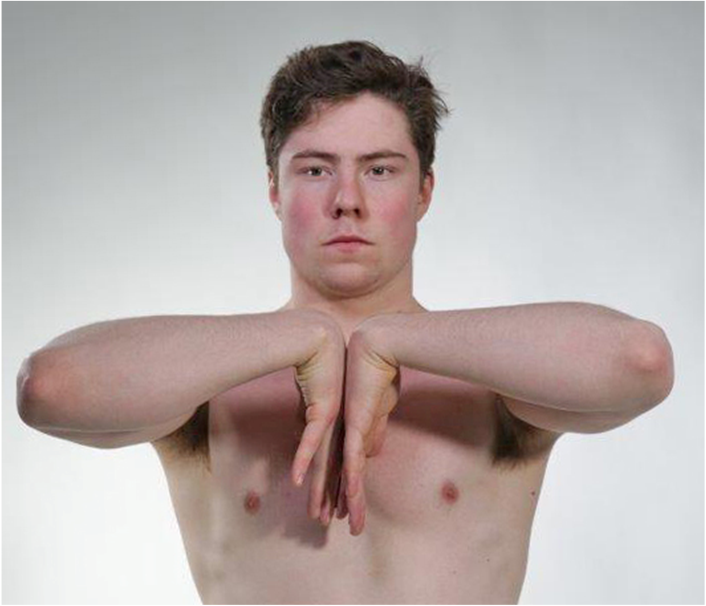
Passive flexion of the wrist causes paresthesias within 1–2 minutes
Carpal tunnel syndrome, Durkin test
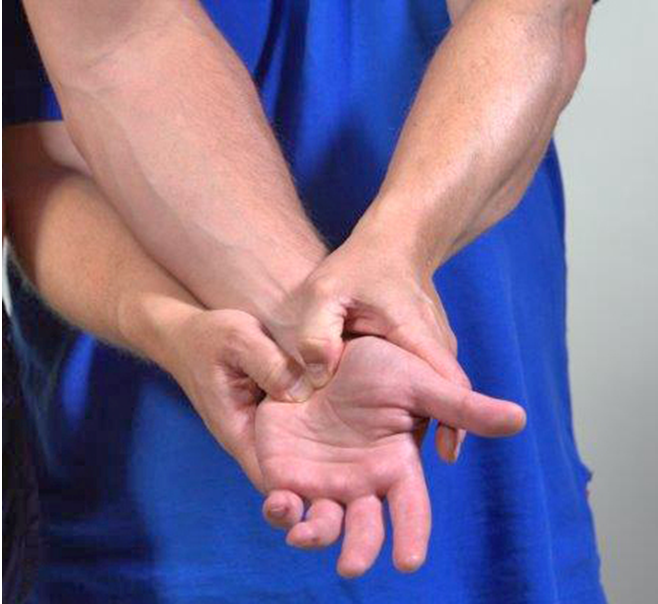
Pressure on the median nerve in the carpal tunnel for 10-15 seconds causes paresthesias in the median nerve area
Carpal tunnel syndrome, consequential condition "Ape hand"


- Atrophy in the abductor pollicis brevis muscle causes the thumb to remain in an adducted and radially rotated position
- Atrophy of the M. opponens pollicis and M. flexor pollicis brevis causes the thumb to be unable to rotate medially and flex at the thumb's carpometacarpal joint (saddle joint), this makes thumb opposition impossible
- Slight clawing in the index and middle fingers due to atrophy in the two radial Mm. lumbricales (lack of extension strength in the PIP and DIP joints)
Key diagnostics, N. medianus