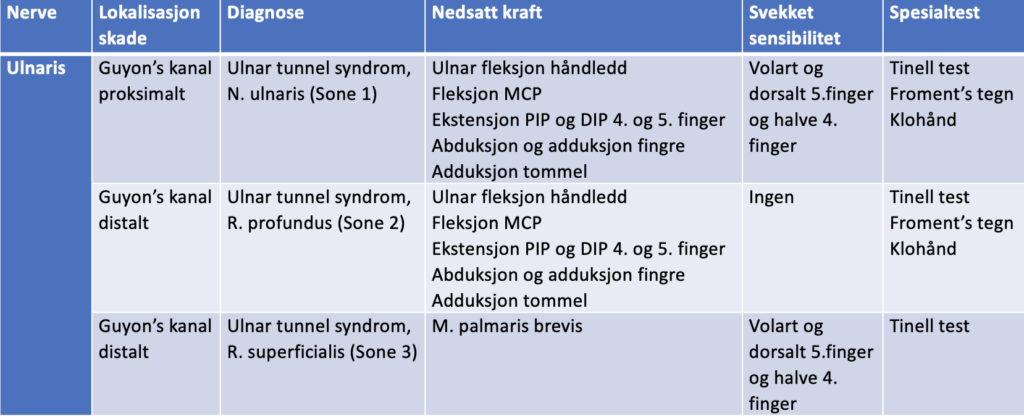
Ulnar tunnel syndrome, causes

Pressure on N. ulnaris in Guyon’s canal
- Ganglion cyst
- Chronic repeated trauma or pressure on the hypothenar area
- Fracture
Ulnar tunnel syndrome, Tinel test
Tinel test Guyon's canal

Ulnar tunnel syndrome, anatomy of Guyon's canal
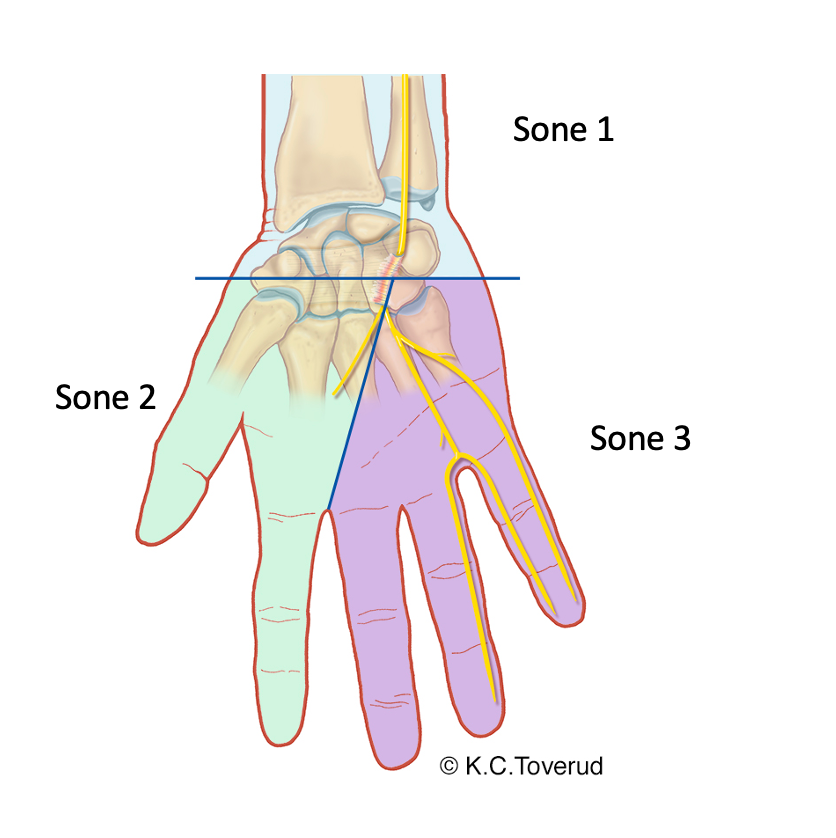
Three zones in Guyon's canal where the nerve can be exposed to pressure or injury
- Zone 1 N. ulnaris
- Zone 2 R. profundus, purely motor branch
- Zone 3 R. superficialis, combined motor and sensory branch
Ulnar tunnel syndrome, motor deficit zone 1

Claw hand when the hand is opened
- Hyperextension in MCP of 4th and 5th finger
- Partial flexion in the DIP and PIP joints of the 4th and 5th fingers
- In ulnar tunnel syndrome, the M. flexor digitorum profundus is intact, which leads to more flexion in the DIP joints of the 4th and 5th fingers, resulting in a more pronounced claw hand than in cubital tunnel syndrome
Weakness in M. palmaris brevis
Ulnar tunnel syndrome, zone 1
Weakness in M. palmaris brevis
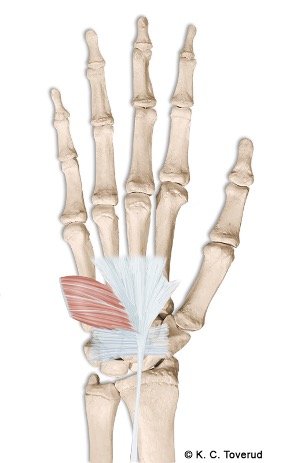
- M. palmaris brevis is located over the hypothenar muscles
- Innervated by the superficial branch (R. superficialis) of N. ulnaris, which branches off just after Guyon's canal
- The muscle is identified by asking the patient to abduct the little finger against resistance and observe whether the skin becomes wrinkled over the hypothenar area
Ulnar tunnel syndrome, motor deficit zone 1
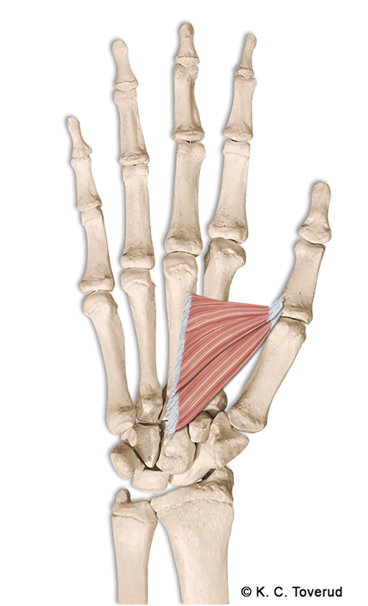
Froment’s sign
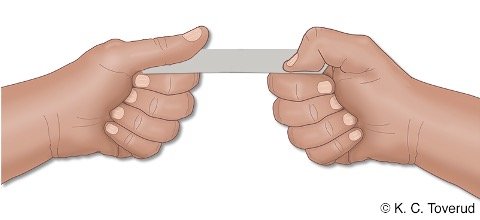
- M. adductor pollicis weakness
- Weak thumb adduction
- M. flexor pollicis longus has normal strength (innervated by N. interosseus anterior, branch of N. medianus)
- Flexion in the thumb’s interphalangeal (IP) joint is normal.
- The IP joint is flexed to hold the paper.
Froment’s sign
Weakness in M. adductor pollicis, innervated by N. ulnaris C8-Th1
Normal strength in M. flexor pollicis longus, innervated by N. medianus C8-Th1

Ulnar tunnel syndrome, sensory loss in zone 1

- Reduced sensation corresponding to the innervation area of R. dorsalis nervi ulnaris and R. superficialis
- Preserved sensation in R. palmaris nervi ulnaris as the branch arises before Guyon’s canal
Ulnar tunnel syndrome, zone 2
- Compression at R. profundus
- Muscle weakness in hand muscles innervated by the ulnar nerve (claw hand and positive Froment's sign)
- Preserved sensation in the ulnar area
- No muscle weakness in M. palmaris brevis
Ulnar tunnel syndrome, zone 3
- Compression of the R. superficialis
- Normal strength in hand muscles innervated by the ulnar nerve
- Sensory loss in the innervation area of R. superficialis
- Weakness in M. palmaris brevis
Key diagnostics, ulnar nerve